

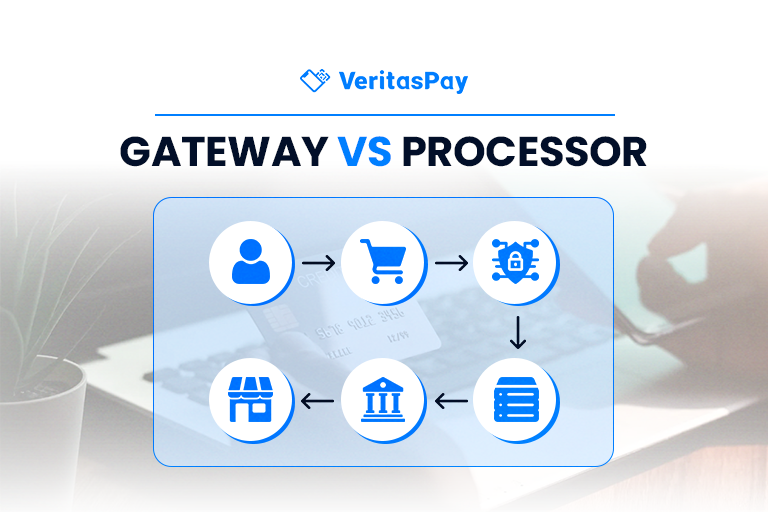
A “payment gateway” and a “payment processor” sound similar on the surface as both seem to imply that there is a path for a payment. They differ more than you think.
When a customer clicks “Pay,” the process may look simple. Behind that quick confirmation, however, several systems work to move payment information from the customer to the business. While they closely work together, they do different jobs.
What Is a Payment Gateway?
Think of a payment gateway as a secure doorway for payment information.
When a customer enters their card details or other payment information, the gateway securely captures and sends that information to the systems handling the transaction. It connects the customer’s checkout experience with the payment infrastructure behind it.
Once the transaction has been processed, the gateway also helps send the result back to the business and, in many cases, the customer.
In simple terms, the gateway helps payment information get where it needs to go securely.
What Is a Payment Processor?
The payment processor handles the transaction as it moves between the different parties involved in a payment.
It communicates transaction information with relevant payment networks and financial institutions, helping determine whether a payment can be approved or declined. The result is then passed back through the payment process.
Put simply, the processor helps handle the transaction once the payment information has been sent.
Gateway vs. Processor: How Are They Different?
The easiest way to understand the difference is to look at the role each one plays in the transaction.
Payment gateways securely capture payment information, connect the checkout to the payment process, send transaction details to the processor, and return the transaction result to the merchant.
Payment processors, on the other hand, handle the transaction itself. They communicate with payment networks and financial institutions, facilitate authorization, and help move the transaction through the payment process.
In simple terms, a payment gateway and a payment processor are different components that work together as part of the same payment journey.
How Do They Work Together?
Imagine a customer buying something online. When the customer clicks “Pay,” the payment gateway securely sends the payment information to the payment processor. The processor then handles the transaction by communicating with relevant payment networks and financial institutions. Once the transaction is processed, the result is sent back through the payment system, and the customer sees whether the payment was successful or declined.
If something goes wrong, the impact can be felt by both the customer and the business. A failed transaction, unclear payment status, or delayed confirmation can interrupt a sale and create extra work.
What Does This Mean for Businesses?
Businesses do not necessarily need to choose between a payment gateway and a payment processor. In many setups, both are part of the payment solution.
The more important question is whether the overall payment system works well for the business.
A payment solution should not add unnecessary complexity. Ideally, the different parts work together in the background while customers get a simple and reliable way to pay.
The Bottom Line
The goal is not simply to accept payments. It is to have a payment system that works reliably behind every transaction while making things easier for both the business and its customers.
As a payment provider for businesses, VeritasPay is backed with a high-quality gateway and processor that helps businesses access payment solutions designed to support secure, reliable, and seamless transactions.
As VeritasPay continues to provide high-quality payment solutions and promote cashless transactions, the company is also dedicated in bringing in fresh and informative content. We’ll be continuing to share new articles about our products, services, and varying subjects within the industry as we move forward.
Contact us here to know more.